
What Documents Are Needed to Trade In a Car?
What Documents Are Needed to Trade In a Car?
Posted on May 15, 2026
What Documents Are Needed to Trade In a Car? Your 2026 Ontario Guide
Your folder of service records and ownership papers is actually a silent negotiator that can add real value to your trade-in offer. If you're wondering what documents are needed to trade in a car, you're likely looking for a way to secure a premium valuation without the headache of administrative delays. It's common to feel anxious about being turned away due to a missing signature or confusion over Ontario-specific requirements like the Used Vehicle Information Package (UVIP). We believe the process should be transparent and rewarding, not a source of stress or uncertainty.
This guide will give you total clarity on the 2026 requirements, ensuring you walk into the dealership with complete confidence. You'll learn how to leverage your maintenance history for a higher valuation and exactly how to handle a vehicle that still has an active loan. We've prepared a definitive checklist of every physical and digital document you need to seamlessly trade in your current ride for a quality used SUV, sedan, or truck today.
Key Takeaways
- Learn why the Ontario Vehicle Permit (the "green slip") is the most critical document and how to properly separate the plate and vehicle portions for a legal transfer.
- Understand what documents are needed to trade in a car that still has an active loan, specifically the role of the payout letter in clearing liens.
- Discover how organized service records act as a value-building asset that helps you negotiate a higher trade-in price than the market average.
- Identify the physical items, like spare key fobs and owner’s manuals, that can surprisingly impact your final appraisal offer if left at home.
- See how a professional dealer handles complex administrative tasks like UVIP procurement and ownership transfers to save you time and eliminate risk.
The Essential Legal Documents for an Ontario Trade-In
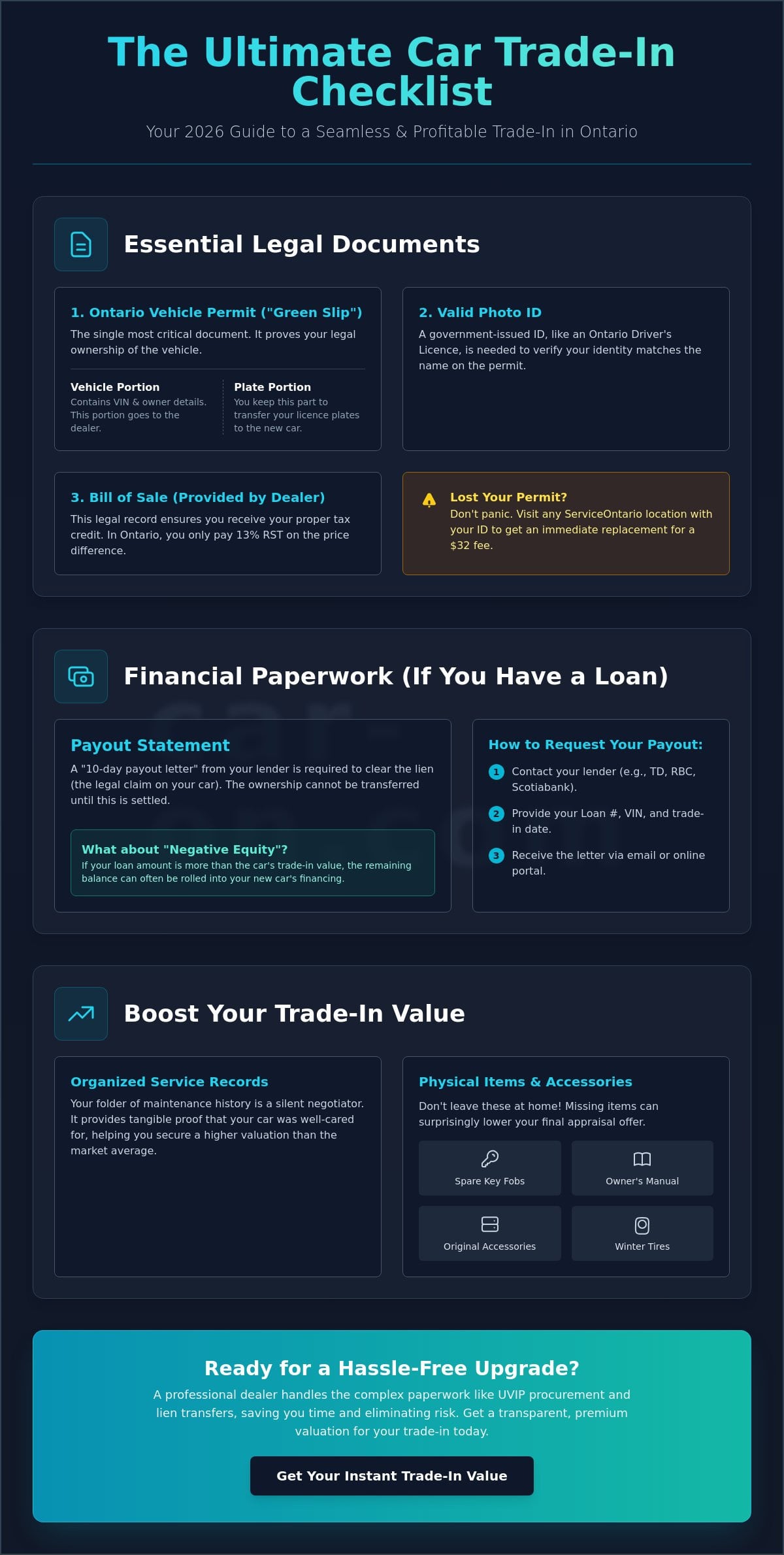
Establishing legal ownership is the first step toward a successful transaction. When you ask what documents are needed to trade in a car in Ontario, the conversation starts and ends with the "Green Paper." This document, officially known as the Ontario Vehicle Permit, serves as the primary Vehicle Title. Without it, the dealership cannot legally take possession of your car. You'll also need a valid government-issued photo ID, such as an Ontario Driver's Licence, to prove that you are the person named on the permit. This simple verification protects both you and the dealer from potential fraud or title disputes.
The Bill of Sale is another critical piece of the puzzle. In a dealership trade-in, this document outlines the value being applied against your next purchase. It's more than just a receipt; it's a legal record that ensures you receive the proper tax credit. In Ontario, you only pay the 13% Retail Sales Tax (RST) on the "difference" between your trade-in value and the price of your new vehicle. Understanding what documents are needed to trade in a car ensures you don't leave this significant tax savings on the table. While private sellers must provide a Used Vehicle Information Package (UVIP) for $20, we typically handle these administrative details for you to keep the process moving quickly.
The Ontario Permit: Vehicle vs. Plate Portions
The green permit is actually two distinct documents printed on one sheet. The "Vehicle" portion contains the VIN and owner details, which the dealer keeps to transfer ownership. The "Plate" portion belongs to you. In Ontario, licence plates are linked to the driver, not the vehicle. You'll keep this portion to move your plates to your next SUV, truck, or sedan. If your permit is ripped or the ink has faded to the point of being illegible, you'll need to replace it before the trade can be finalized. A clean, readable permit is the foundation of a risk-free transfer.
What to Do if You Lost Your Ownership Papers
Don't panic if you can't find your green slip in the glovebox. You can obtain a replacement immediately by visiting any Service Ontario location. You'll need to bring your ID and pay the standard $32 fee for a new vehicle permit. At Car-On Auto Sales, we understand that life happens. We can often assist in the verification process or guide you through the exact steps needed to recover your documentation. Our goal is to remove the administrative burden so you can focus on choosing your next quality used vehicle with total peace of mind.
Financial Paperwork: Handling Liens and Outstanding Loans
Trading in a vehicle that isn't fully paid off is a standard part of the modern car-buying process. With the average monthly auto loan payment in Canada approaching $1,000 in 2026, many drivers arrive at the dealership with an active balance. When you are determining what documents are needed to trade in a car with a loan, the most critical item is the payout statement. A lien is simply a legal claim your bank or lender holds over the vehicle until the debt is settled. According to the Ontario government, a vehicle cannot have its ownership fully transferred until all registered liens are cleared. This sounds intimidating, but a professional dealer manages this complexity for you every day.
You might encounter "negative equity," which happens if your car’s current trade-in value is lower than the amount you still owe the bank. This is common in a market where used car prices have stabilized at high levels after the volatility of previous years. If this applies to you, don't worry. We can often roll that remaining balance into your new used car financing package, allowing you to transition into a more reliable SUV or truck without a massive upfront cash payment. Having your financial paperwork ready ensures this transition is smooth and transparent.
Requesting a Payout Statement from Your Lender
To get started, you must contact your lender for a "10-day payout" letter. This document shows exactly how much is required to pay off the loan in full, including any daily interest accrued over the next ten days. Most major Canadian institutions like TD Auto Finance, RBC, or Scotiabank can provide this via email or their online banking portals. When you call, have these details ready:
- Your full account or loan number.
- The 17-digit Vehicle Identification Number (VIN).
- The exact date you plan to finalize your trade-in.
Trading In a Car with a Lien: The Process
Once you provide the payout letter, the dealership takes over the heavy lifting. We pay the lender directly to clear the lien from the provincial registry. This effectively "releases" the bank's interest in the car, allowing the ownership to be legally transferred to us. This process is far safer than a private sale, where a buyer might be hesitant to take on a vehicle with an active debt. Understanding what documents are needed to trade in a car allows you to step into the dealership with a clear financial picture and zero administrative anxiety.
Maintenance Records: Proving Your Car’s Value
Your vehicle's maintenance history is more than a list of past chores. It's a powerful negotiation tool. When people ask what documents are needed to trade in a car, they often focus on the legal minimums, but the smart seller focuses on value. A car with a documented history of synthetic oil changes and scheduled brake services is worth more to a dealer than one with a mystery past. We look at your records to see if you've followed the manufacturer's suggested intervals. This reduces our risk, which translates directly into a higher appraisal for your used SUV, sedan, or truck.
CarFax reports are the industry standard for verifying a vehicle's history, but they don't always tell the whole story. These reports rely on shops reporting the work to a central database. If you used a local independent garage that doesn't report to CarFax, your physical receipts become your only proof of maintenance. Proving you replaced a timing belt, serviced the transmission, or installed a fresh set of premium tires within the last 12 months can significantly bump your trade-in offer. These are high-cost items that a dealer would otherwise have to account for during reconditioning. By showing you've already handled them, you're essentially putting that money back into your own pocket.
Organizing a Service History Folder
A messy pile of crinkled receipts won't help your case as much as a structured folder. Organize your invoices chronologically. This allows the appraiser to see a consistent pattern of care at a glance rather than a series of reactive repairs. Be sure to highlight any transferable extended warranty coverage you've purchased. This is a massive selling point for the next owner. Even simple oil change receipts matter. They prove the engine hasn't been neglected, which is the first thing we check during our multi-step inspection process. This level of transparency builds the trust necessary for a premium offer.
Leveraging Digital Service Apps
Modern drivers often have their records stored in manufacturer apps like those from Toyota or Ford. These are fantastic for showing dealer-performed service and recall completions. Before your appraisal, export these records or have the app ready on your phone to show the appraiser. If you've been a regular customer of ours, we already have your history on file, including our Lifetime Oil Changes program. This built-in transparency makes the trade-in process faster and ensures you get the maximum value for your vehicle without digging through a physical glovebox. Knowing exactly what documents are needed to trade in a car, both digital and physical, puts the control back in your hands.
The Physical 'Documents': Keys, Manuals, and Accessories
When you're gathering what documents are needed to trade in a car, don't stop at the paper records. Think of your spare key fobs, owner’s manuals, and wheel lock keys as physical documentation of your car’s completeness. In the 2026 Ontario market, where used car prices remain historically high, every missing accessory represents a cost a dealer must recoup. If you arrive with only one key, the appraiser must deduct the replacement cost to ensure the next owner has a full set. Providing these items upfront signals that you’ve been a responsible owner. This builds the professional trust needed for a top-tier valuation.
Small electronic components are often more valuable than the paper they accompany. For older models, navigation SD cards or DVD sets are essential for the infotainment system to function as advertised. If these are missing, the system may be useless to the next buyer, forcing the dealer to source expensive replacements. The same applies to the wheel lock key. If we have to break off your locks to service the vehicle, it adds labor costs that lower your offer. While the legal answer to what documents are needed to trade in a car focuses on the permit, these physical "documents" are what protect your bottom line.
The Financial Impact of a Missing Spare Key
Modern proximity fobs are sophisticated computers. Replacing and programming a new one can easily cost between $300 and $600 depending on the manufacturer. If you don't have the original spare, even a high-quality aftermarket key is better than nothing at all. It saves the dealership the time and specialized labor of ordering a new unit from the factory. We always recommend hunting through your home drawers before heading to the dealership. That small piece of plastic and metal is essentially a hundred-dollar bill sitting in your pocket.
Don’t Forget the Accessories
Items like winter tire sets, roof racks, and weather mats aren't legally required, but they are high-value additions. In Ottawa’s climate, a second set of tires is a major selling point for any used SUV or truck. Including these accessories can turn a standard offer into a premium one. Make sure you also include the cargo covers and the original owner’s manual. These small items are often overlooked, but they are essential for the safety and convenience of the next driver. Ready to see what your fully-equipped vehicle is worth? Get a transparent appraisal today and let our team handle the administrative details for you.
How Car-On Auto Sales Simplifies the Ottawa Trade-In Process
Knowing what documents are needed to trade in a car is the first step toward a successful deal. The second step is finding a partner who respects your time and eliminates the administrative burden. At Car-On Auto Sales, we've refined our "Transparency First" appraisal process to ensure you feel secure at every stage. We don't just look at a screen to find a number. We evaluate your vehicle based on its specific maintenance history and the current high demand in the local Ottawa market. Our goal is to provide a professional, mentor-like experience that removes the fear of the unknown.
Administrative hurdles often cause the most anxiety during a trade. In Ontario, a private seller is legally required to provide a Used Vehicle Information Package (UVIP) for $20. When you work with us, we take that task off your plate entirely. We also handle the complex communication with your lender if your vehicle still has an active lien. We coordinate the payout directly, ensuring the debt is cleared and the ownership transfer is seamless. This full-service approach means you won't have to spend your afternoon at ServiceOntario or on hold with a bank. You simply bring the records, and we handle the execution.
The Car-On Advantage for Ottawa Drivers
We've served the Ottawa and Quebec community for over 40 years. This deep local experience allows us to value your trade-in more accurately than a national algorithm ever could. We know that a used SUV with a documented rust-proofing history is worth a premium in our climate. We're proud to offer a 30-Day Money-Back Guarantee on our vehicles, providing a level of security you won't find in a private sale. While our team prepares your appraisal, feel free to explore our current used car inventory at our 1700 Cyrville Rd showroom to see what's waiting for you.
Ready to Trade? Here is Your Final Checklist
Before you visit us, use this final checklist to ensure you're fully prepared. Having these items ready allows us to finalize your offer and get you behind the wheel of your next vehicle faster. If you're unsure about what documents are needed to trade in a car in your specific situation, don't hesitate to call us ahead of time.
- The Green Permit: Bring both the vehicle and plate portions of your Ontario ownership papers.
- Valid Photo ID: Your Ontario Driver’s Licence is required to verify ownership.
- Loan Information: Bring your most recent statement or a 10-day payout letter from your lender.
- Maintenance History: Any physical receipts or access to your digital service apps.
- All Keys and Fobs: Including the spare sets and wheel lock keys.
Our team is ready to provide a fair, transparent valuation that reflects the true worth of your vehicle. You can even start the process from home. Get your instant trade-in estimate online today and see how simple a professional trade-in can be.
Drive Away with Confidence and Maximum Value
You now have a complete roadmap for your next vehicle upgrade. By organizing your Ontario vehicle permit, securing your loan payout letter, and gathering your maintenance records, you've transformed a simple administrative task into a value-building strategy. Knowing exactly what documents are needed to trade in a car is the best way to ensure you walk away with the highest possible offer for your current SUV, truck, or sedan. These preparations protect you from delays and put the power of negotiation back in your hands.
We've been serving the Ottawa community since 1982, and our team is ready to handle the heavy lifting for you. From clearing complex liens to managing ownership transfers, we ensure your transition is risk-free and rewarding. Every vehicle we sell comes with the security of a 30-Day Money-Back Guarantee and the long-term benefit of Lifetime Oil Changes. Don't let paperwork stand between you and your next ride. Start your hassle-free trade-in appraisal at Car-On Auto Sales today. We're here to make your next move the easiest one yet.
Frequently Asked Questions
Do I need a Safety Standards Certificate (SSC) to trade in my car?
No, you don't need to provide a Safety Standards Certificate when trading your vehicle to a dealership. Dealers are licensed to purchase cars in "as-is" condition and will perform their own multi-step safety inspections during the reconditioning process. This is a significant advantage over private sales, where a valid SSC is typically required for the buyer to plate and register the vehicle.
Can I trade in a car if the ownership is in someone else’s name?
You cannot trade in a vehicle unless you are the legal owner listed on the Ontario permit. If the car belongs to a family member or spouse, that individual must be present to sign the transfer papers or provide a notarized power of attorney. This legal requirement ensures the transfer of the vehicle title is valid and protects all parties from unauthorized transactions.
What if I still owe more on my car than it is worth?
You can still trade in a vehicle with negative equity. The dealership will calculate the difference between your trade-in value and your current loan balance. We can often roll this remaining amount into your new financing package for a used SUV or truck. This allows you to upgrade your vehicle without needing to pay off the entire outstanding debt in a single cash payment.
Is a CarFax report required for a trade-in?
You aren't required to purchase or provide your own CarFax report when trading in at a dealership. We pull our own comprehensive history reports as part of our professional appraisal process. While you don't need to buy a report, bringing your own maintenance receipts is still highly recommended. These papers prove specific services, like oil changes or brake work, that might not appear on a digital history report.
Do I need to provide a UVIP when trading in to a dealer in Ontario?
You aren't required to provide a Used Vehicle Information Package (UVIP) when selling or trading your car to a registered dealer. While this is a mandatory $20 document for private sales, the dealership handles the background and lien checks internally. This is one of the main ways we simplify what documents are needed to trade in a car for our Ottawa customers.
How long is a trade-in appraisal and offer valid for?
Trade-in offers are typically valid for 7 days or a limited number of additional kilometers, usually around 500 km. Because the used car market is dynamic and vehicle mileage increases daily, these offers have an expiration date. If you return after the offer has expired, we'll perform a quick re-appraisal to ensure the valuation still reflects the current market demand and your car's condition.
Can I trade in a vehicle registered in Quebec to an Ontario used car dealer like Car-On Auto?
Yes, we frequently accept trade-ins for vehicles registered in Quebec. You'll need to provide your Quebec registration documents and proof of any active liens from Quebec-based lenders. Our team is experienced with cross-border transactions for drivers in Gatineau and the surrounding region. We'll guide you through the specific steps to ensure your out-of-province transfer is handled correctly and without any administrative stress.
What happens to my license plates after the trade-in?
In Ontario, your license plates stay with you, not the vehicle. After the trade-in is finalized, you'll remove your plates from the old car. You can then choose to attach them to your new used vehicle or return them to a Service Ontario location. If you don't plan on replacing the vehicle immediately, you may even be eligible for a refund on the remaining validation period for those plates.